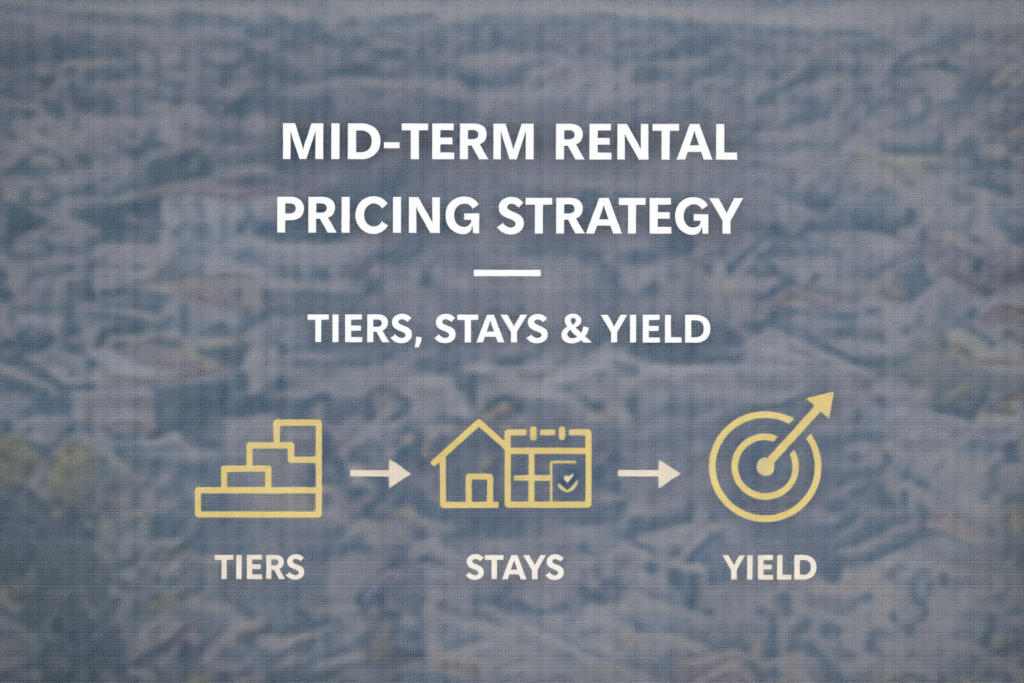
Why Pricing Strategy Matters More Than Occupancy
High occupancy does not always mean strong returns.
Poor pricing leaks value over time. A clear mid-term rental pricing strategy helps operators protect yield while keeping demand stable. This guide supports the pillar Mid-Term Rental Portfolio Strategy: Capital, Growth & Exits, where pricing decisions directly shape cash flow and long-term asset value.
Pricing is not about filling nights.
It is about controlling revenue per stay.
What a Mid-Term Rental Pricing Strategy Really Is
Pricing strategy is a system, not a number.
It balances demand, stay length, and operational cost.
A strong mid-term rental pricing strategy considers:
- Length of stay patterns
- Extension behavior
- Turnover costs
- Channel fees
- Market-specific demand
When pricing works, extensions increase and costs drop.
Length-of-Stay Is the Core Pricing Lever
Mid-term rentals behave differently than short-term stays.
Longer stays reduce friction and expense.
Focus on:
- 30-day base rates
- 60-day optimized rates
- 90-day stability rates
Short stays drive turnover.
Long stays drive margin.
Building Tiered Pricing That Converts
Tiered pricing guides guest decisions.
It rewards commitment without heavy discounts.
Effective tiers include:
- Base rate for 30 days
- Reduced rate for 60 days
- Best rate for 90+ days
A clear mid-term rental pricing strategy makes longer stays feel like the smart choice.
Extension Pricing: Where Yield Is Won or Lost
Extensions matter more than new bookings.
They reduce marketing and cleaning costs.
Best practices include:
- Sending extension offers around day minus 14
- Offering two or three rate options
- Avoiding last-minute discounts
Guests often extend when prompted early.
Channel-Specific Pricing Without Conflict
Different channels attract different guests.
Pricing must stay consistent at the core.
For clean pricing:
- Publish one base monthly rate
- Adjust only through controlled rules
- Avoid undercutting your direct site
- Use flexibility, not discounts, for direct bookings
Consistency protects brand trust.
Accounting for Turnover and Operating Costs
Pricing must cover real costs.
Ignoring turnover destroys margin.
Include:
- Cleaning and inspections
- Maintenance resets
- Utilities during vacancies
- Furnishing wear
A proper mid-term pricing strategy prices for net profit, not gross rent.
Market-Based Pricing Adjustments
Markets behave differently.
Uniform pricing fails across regions.
Adjust for:
- Local demand drivers
- Seasonality
- Corporate presence
- Regulatory pressure
Review market pricing quarterly.
Reprice underperforming units quickly.
Testing Pricing Changes Without Risk
Pricing tests should be controlled.
Random changes create noise.
Test by:
- Adjusting one variable at a time
- Tracking extension rate changes
- Monitoring occupancy shifts
- Comparing similar units
Data should confirm every change.
Using Data to Control Yield
Yield control relies on visibility.
Without data, pricing stays reactive.
Track:
- Revenue per available month
- Average length of stay
- Extension conversion rate
- Net revenue after fees
Strong data supports confident pricing decisions.
How Marketplaces Support a Mid-Term Rental Pricing Strategy
Marketplaces provide demand signals.
They show what guests accept in real time.
Platforms like MiniStays.com help operators observe pricing tolerance, stay length trends, and extension behavior without committing to long-term assumptions.
Use this insight to refine your pricing model.
When to Reprice or Exit Using a Mid-Term Rental Pricing Strategy
As portfolios grow, pricing must stay consistent.
Ad hoc decisions do not scale.
Standardize:
- Tier definitions
- Extension rules
- Channel adjustments
- Review cadence
Consistency simplifies training and reporting.
When to Reprice or Exit Using a Mid-Term Rental Pricing Strategy
Pricing reveals asset quality.
Units that need constant discounts signal deeper issues.
Reprice or exit when:
- Extensions stay low
- Turnover costs stay high
- Demand weakens long term
Pricing data guides capital redeployment.
How a Mid-Term Rental Pricing Strategy Fits the Portfolio Plan
Pricing decisions affect refinancing, partnerships, and exits.
They sit at the heart of Mid-Term Rental Portfolio Strategy: Capital, Growth & Exits.
Strong pricing creates predictable cash flow.
Predictable cash flow creates options.
Final Call: Control Yield With a Mid-Term Rental Pricing Strategy
Growth without pricing discipline creates stress.
A clear mid-term pricing strategy protects margin, extends stays, and simplifies scaling.
Design tiers with intent.
Prompt extensions early.
Adjust pricing using data, not instinct.
Test demand through platforms like MiniStays.com, then deploy capital where pricing power stays strong and predictable.