Snowbird Destinations: Top 10 U.S. Cities for Snowbirds & Remote Workers in 2026
The best snowbird destinations in 2026 combine mild winters, furnished monthly housing, healthcare access, reliable connectivity, and enough everyday amenities for a 30–90+ day stay. In our experience with mid-term rentals, Tampa, Tucson, Phoenix, Jacksonville, San Antonio, Las Vegas, Orlando, Austin, Savannah, and Charleston stand out because they can serve both seasonal residents and location-flexible professionals.
Snowbird Destinations vs. Remote Worker Destinations
Mild winter conditions. Traditional snowbirds prioritize warmer climates during the coldest months, which gives Florida, Arizona, Texas, Nevada, Georgia, and South Carolina a natural advantage.
Furnished monthly housing. Strong winter rental destinations need move-in-ready properties that work for one to three months without requiring renters to furnish a temporary home.
Healthcare access. Proximity to hospitals, specialists, pharmacies, and medical centers is particularly important for retirees and can also create a second demand stream from healthcare professionals.
Remote-work practicality. Reliable Wi-Fi, a dedicated workspace, comfortable living areas, parking, and access to restaurants and services help a property appeal to remote professionals as well as snowbirds.
Multiple demand seasons. Hosts benefit when a market can attract corporate travelers, clinicians, military personnel, relocating households, and other mid-term renters outside peak snowbird months.
For a broader market comparison, see our guide to top U.S. cities for mid-term rentals.
Best Snowbird Destinations: 2026 Comparison
The best cities for snowbirds are not necessarily the cheapest rental markets. Hosts should balance winter appeal with housing costs, healthcare access, seasonal competition, and year-round demand.
The rent figures below are broad Zillow asking-rent benchmarks for all bedrooms and property types. They are not furnished MTR rates, but they provide a useful baseline before hosts research property-level furnished comps.
| Rank | Destination | 2026 Rental Benchmark | Key Demand Angle | Best For |
|---|---|---|---|---|
| 1 | Tampa, FL | ~$2,000 | Winter + healthcare + military | Traditional snowbirds |
| 2 | Tucson, AZ | ~$1,500 | Desert winter + healthcare | Value-conscious snowbirds |
| 3 | Phoenix, AZ | Research live comps | Healthcare + corporate + winter | Snowbirds + remote workers |
| 4 | Jacksonville, FL | ~$1,600 | Healthcare + Navy + winter | Mixed MTR demand |
| 5 | San Antonio, TX | ~$1,600 | Military + healthcare | Longer winter stays |
| 6 | Las Vegas, NV | ~$1,945 | Winter + entertainment economy | Remote professionals |
| 7 | Orlando, FL | Research live comps | Winter + relocation + healthcare | Flexible renters |
| 8 | Austin, TX | ~$1,990 | Technology + remote work | Remote professionals |
| 9 | Savannah, GA | ~$1,978 | Mild winter + lifestyle | Lifestyle snowbirds |
| 10 | Charleston, SC | ~$2,900 | Coastal lifestyle + healthcare | Higher-budget renters |
These snowbird destinations offer different combinations of winter climate, monthly housing costs, healthcare access, and year-round mid-term rental demand. These benchmarks show why hosts should not choose a market based on climate alone. For example, late-August 2026 asking rents ranged from about $1,500 in Tucson to $2,900 in Charleston.
1. Tampa, Florida: Best Overall for Traditional Snowbirds
Why it ranks / Best for: Tampa combines Florida’s established winter appeal with healthcare, military, corporate, and relocation demand that can extend beyond snowbird season.
Demand drivers: Tampa General Hospital, MacDill Air Force Base, University of South Florida, downtown employers, beaches, and the broader Tampa Bay retirement and relocation market.
2026 number: According to Zillow’s Tampa rental market data, the average asking rent was approximately $2,000 across all bedrooms and property types on August 31, 2026.
Context: Tampa’s winter popularity creates opportunity, but it also creates competition. Hosts should compare furnished monthly inventory before assuming peak-season pricing.
Tampa works particularly well for snowbird rentals because a property can potentially pivot toward healthcare, military, corporate, or relocation renters after winter.
2. Tucson, Arizona: Best Value Snowbird Destination
Why it ranks / Best for: Tucson offers the classic Arizona winter lifestyle with a lower broad-market rental benchmark than several destinations in this ranking.
Demand drivers: University of Arizona, Banner-University Medical Center Tucson, Davis-Monthan Air Force Base, retirees, university visitors, healthcare workers, and remote professionals.
2026 number: Zillow reported an average asking rent of approximately $1,500 in Tucson as of August 30, 2026, down about $100 from a year earlier.
Context: Tucson’s softer broad-market rent trend means hosts should avoid assuming that seasonal popularity automatically supports aggressive monthly price increases.
For snowbirds seeking sunshine without South Florida pricing, Tucson deserves serious consideration. For hosts, its university, military, and healthcare institutions also provide alternative MTR demand.
3. Phoenix, Arizona: Best for Big-City Winter Demand
Why it ranks / Best for: Phoenix combines desert winters with a large employment base, major healthcare institutions, corporate relocation, and access to the wider Valley.
Demand drivers: Banner Health, Mayo Clinic, Arizona State University’s regional presence, semiconductor employers, corporate offices, retirees, and seasonal residents.
2026 number: Furnished rates vary substantially across Phoenix, Scottsdale, Tempe, Mesa, and other Valley communities, so hosts should research current property-level 30+ day comps rather than rely on a single metro average.
Context: “Phoenix” is too broad for MTR underwriting. A Scottsdale snowbird property and a furnished unit serving a Phoenix healthcare employer can have very different renter profiles.
Phoenix remains one of the most versatile snowbird destinations because hosts can potentially reach both traditional winter residents and working-age renters.
4. Jacksonville, Florida: Best for Snowbird + Healthcare + Military Demand
Why it ranks / Best for: Jacksonville gives hosts more than warm-weather appeal because the city also has major healthcare and naval demand generators.
Demand drivers: Mayo Clinic Florida, Baptist Health, UF Health Jacksonville, Naval Air Station Jacksonville, and Naval Station Mayport.
2026 number: Zillow reported an average Jacksonville asking rent of approximately $1,600 across all bedrooms and property types on August 30, 2026.
Context: Jacksonville is geographically large. A rental serving Mayo Clinic should be evaluated differently from a property near NAS Jacksonville or Mayport.
This diversified renter base can make Jacksonville particularly useful for hosts who do not want their snowbird rentals to depend exclusively on seasonal retirees.
5. San Antonio, Texas: Best for Winter + Military Demand
Why it ranks / Best for: San Antonio offers mild winters, cultural attractions, relatively accessible broad-market rents, and one of America’s most significant military ecosystems.
Demand drivers: Joint Base San Antonio, Fort Sam Houston, Brooke Army Medical Center, Lackland, Randolph, University Health, and corporate employers.
2026 number: Zillow’s Rental Manager reported an average asking rent of approximately $1,600 across San Antonio on August 31, 2026, with 6,478 rentals represented in its dataset.
Context: Hosts should choose the demand generator first. A unit positioned for Fort Sam Houston is not necessarily convenient for a renter working near Lackland or Randolph.
San Antonio can therefore work as a winter rental destination while retaining military, healthcare, and relocation demand during other parts of the year.
6. Las Vegas, Nevada: Best for Remote Workers Who Want Entertainment
Why it ranks / Best for: Las Vegas combines a relatively mild desert winter with dining, entertainment, airport connectivity, and a large inventory of rental housing.
Demand drivers: Hospitality employers, convention activity, healthcare facilities, corporate travelers, seasonal residents, and location-flexible professionals.
2026 number: Zillow reported an average asking rent of approximately $1,945 in Las Vegas as of August 31, 2026. Its dataset included more than 6,000 available rentals.
Context: Remote workers and retirees can want very different environments. Hosts should decide whether their unit is positioned for quiet residential stays or entertainment-oriented renters.
For remote worker destinations, Las Vegas can offer something traditional retirement markets cannot: a large-city lifestyle paired with a warm-weather winter base.
7. Orlando, Florida: Best for Flexible Winter Lifestyles
Why it ranks / Best for: Orlando gives winter renters warm weather, a major airport, healthcare access, entertainment, and a diversified regional economy.
Demand drivers: Orlando Health, AdventHealth, tourism and hospitality employers, corporate relocations, conferences, and Central Florida’s large service economy.
2026 number: Furnished monthly rates vary sharply by neighborhood and property type, so hosts should research current 30–90+ day furnished comps before underwriting revenue.
Context: Orlando has enormous short-stay tourism visibility. Hosts evaluating MTRs should separate vacation-rental competition from true monthly furnished demand.
That distinction matters. A successful 30–90+ day Orlando property should solve the needs of temporary residents rather than simply operate like a vacation rental with a longer minimum stay.
8. Austin, Texas: Best for Remote Workers
Why it ranks / Best for: Austin is one of the strongest options on this list for working-age renters who want a mild winter without giving up a technology-oriented professional environment.
Demand drivers: University of Texas at Austin, major technology employers, healthcare systems, startups, corporate relocations, and professional services.
2026 number: Zillow reported an average asking rent of approximately $1,990 across all bedrooms and property types on August 28, 2026. That was about $60 below the previous year’s level.
Context: Austin’s broad-market rent softness makes accurate pricing particularly important. Hosts should not underwrite a furnished premium without current neighborhood comps.
Austin may be less traditional than Florida or Arizona as a snowbird market, but it can be one of the better remote worker destinations for professionals seeking a temporary winter base.
9. Savannah, Georgia: Best for Historic Lifestyle Appeal
Why it ranks / Best for: Savannah offers mild-weather appeal, historic character, healthcare and military demand, and a lifestyle that can attract retirees and remote professionals.
Demand drivers: Memorial Health University Medical Center, St. Joseph’s/Candler, Savannah College of Art and Design, Gulfstream Aerospace, Hunter Army Airfield, and the Port of Savannah.
2026 number: Zillow’s Rental Manager put Savannah’s average asking rent at approximately $1,978 on August 31, 2026. Zillow’s broader housing-market series reported a July average rent of $1,798 and typical home value of $325,155.
Context: Savannah combines leisure appeal with institutional demand, but hosts should evaluate local rules and property restrictions before choosing a rental strategy.
That mix makes Savannah one of the more interesting secondary snowbird destinations for hosts seeking alternatives to Florida and Arizona.
10. Charleston, South Carolina: Best for Higher-Budget Snowbirds
Why it ranks / Best for: Charleston combines coastal lifestyle appeal, historic neighborhoods, healthcare, and professional employment, but renters should expect a higher broad-market housing cost.
Demand drivers: Medical University of South Carolina, Roper St. Francis Healthcare, Joint Base Charleston, Boeing, the Port of Charleston, and tourism.
2026 number: Zillow reported an average asking rent of approximately $2,900 across Charleston on August 30, 2026, the highest benchmark among the cities in this comparison with current figures available.
Context: Higher rent can create attractive gross revenue, but it does not automatically mean better returns. Acquisition price, insurance, utilities, vacancy, and furnished competition still matter.
Charleston is better suited to hosts targeting renters who prioritize coastal lifestyle and amenities over finding the lowest-cost winter base.
Snowbird Destinations vs. Remote Worker Destinations
Snowbirds and remote workers overlap, but their priorities are not identical.
| Priority | Traditional Snowbird | Remote Worker |
|---|---|---|
| Warm winter | Very high | High |
| Reliable Wi-Fi | Moderate to high | Essential |
| Dedicated workspace | Moderate | Essential |
| Healthcare access | Very high | Moderate |
| Walkability/dining | High | High |
| Quiet environment | High | High |
| Airport access | Moderate | High |
| Flexible monthly lease | Essential | Essential |
| Furnished property | Essential | Essential |
| Pet-friendly options | Often important | Often important |
The opportunity for hosts is to design a property that can serve both groups. A furnished home with excellent Wi-Fi, workspace, laundry, parking, a complete kitchen, and convenient healthcare access can appeal to retirees in winter and working professionals throughout the year.
Hosts targeting professional renters outside snowbird season can also use our guide to marketing mid-term rentals to corporate clients.
What Should Snowbird Rentals Include?
Strong snowbird rentals should feel like temporary homes rather than hotel rooms. For a 30–90+ day stay, renters need practical features that may not matter during a three-night vacation.
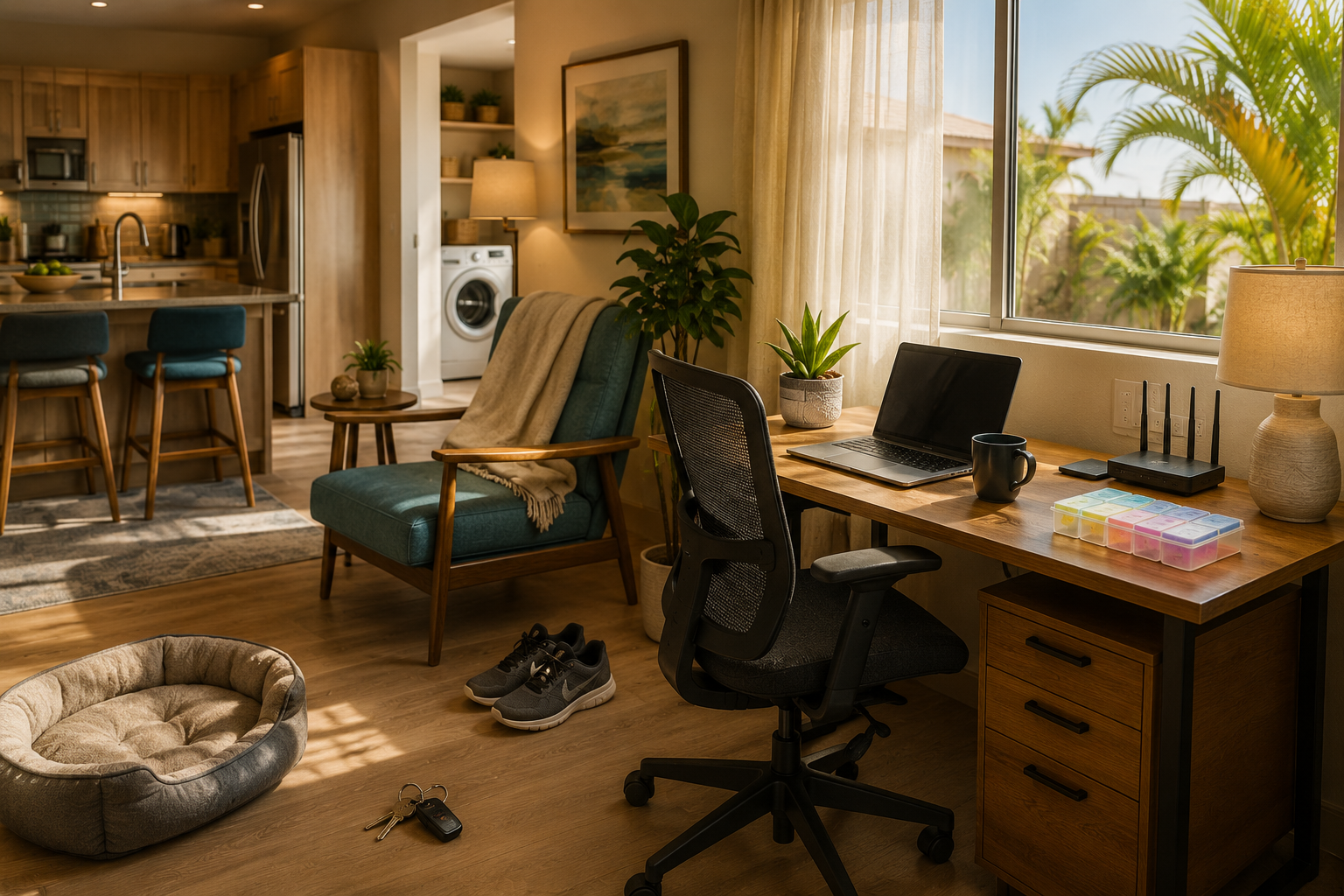
Start with a fully equipped kitchen, comfortable mattress, reliable high-speed internet, laundry access, adequate storage, parking, and comfortable seating. Remote-worker-friendly properties should also have a real desk, supportive chair, accessible outlets, and enough lighting for video calls.
For older renters, consider accessibility factors such as stairs, bathroom layout, parking distance, and ease of entry. Pet-friendly policies can also widen the potential renter pool.
Hosts should price those amenities as part of a complete monthly housing product rather than simply multiplying a nightly rate by 30. Our mid-term rental pricing strategy explains how to build a more realistic monthly rate.
How to Evaluate the Best Cities for Snowbirds
- Identify your primary renter. Decide whether you want retirees, remote professionals, healthcare workers, corporate travelers, or a combination. Your renter profile should determine the neighborhood and property type.
- Check seasonal and year-round demand. The strongest snowbird destinations have backup demand after winter. Look for hospitals, military installations, universities, corporate employers, and relocation activity.
- Research real furnished monthly comps. Compare 30–90+ day rentals with similar bedrooms, utilities, parking, pet policies, workspace, and amenities. Conventional rents are only a baseline.
- Calculate seasonal operating costs. Include utilities, Wi-Fi, furnishings, cleaning, maintenance, insurance, taxes, vacancy, management, HOA expenses, and platform costs.
- Plan for the off-season. A property that works for a travel nurse, relocating employee, military family, or remote professional can reduce reliance on peak winter demand.
For a complete operating framework, see our landlord’s guide to mid-term rentals.
Which Snowbird Destination Is Best in 2026?
Tampa is our strongest all-around starting point for traditional snowbird demand, while Tucson offers a lower broad-market rent benchmark and Austin stands out for remote professionals. Jacksonville and San Antonio deserve special attention from hosts who want military and healthcare demand to supplement winter renters.
Phoenix remains a classic desert option, while Savannah and Charleston offer alternatives for renters who prefer the Southeast. Las Vegas appeals to location-flexible professionals who value entertainment and connectivity.
The larger lesson is that the best snowbird destinations are not simply the warmest cities. For MTR hosts, the strongest market is one where a property can remain useful after the winter migration ends.
Ready to reach renters looking for flexible furnished stays? List your property on ministays and position your rental for 30–90+ day stays.
FAQ
What Makes the Best Snowbird Destinations for 2026?
The best snowbird destinations for 2026 include Tampa, Tucson, Phoenix, Jacksonville, San Antonio, Las Vegas, Orlando, Austin, Savannah, and Charleston. Florida and Arizona remain natural winter choices, while Texas, Nevada, Georgia, and South Carolina offer alternatives. The right city depends on budget, healthcare needs, lifestyle, and preferred length of stay.
Where do most snowbirds go for the winter?
Florida and Arizona are the traditional centers of U.S. snowbird activity because they offer warm winter climates and established seasonal communities. Cities such as Tampa, Phoenix, and Tucson also provide healthcare, recreation, restaurants, and furnished housing. Texas, Nevada, Georgia, and South Carolina can provide additional options for renters seeking different lifestyles or budgets.
What are the best snowbird destinations for remote workers?
Austin, Phoenix, Tampa, Las Vegas, and Jacksonville are strong remote worker destinations to research because they combine warm or mild winters with large-city amenities and diversified economies. Remote professionals should prioritize reliable internet, workspace, airport access, neighborhood amenities, and furnished monthly housing rather than selecting a destination based only on winter temperatures.
How much do snowbird rentals cost per month?
Monthly snowbird rentals vary widely by city, neighborhood, bedroom count, season, amenities, and furnishing quality. As of late August 2026, Zillow’s broad asking-rent benchmarks ranged from about $1,500 in Tucson to $2,900 in Charleston. Furnished winter properties can price differently, so renters and hosts should compare current 30+ day listings.
When should snowbirds book winter rentals?
Snowbirds should begin researching well before their desired winter arrival, particularly when they need a specific neighborhood, pet-friendly home, accessibility features, or multiple bedrooms. Hosts should likewise prepare listings before peak winter demand. Flexible 30-, 60-, and 90-day options can help properties accommodate renters whose arrival and departure dates do not match calendar months.
Are 30–90 day rentals good for snowbirds?
Yes. 30–90 day furnished rentals fit snowbirds particularly well because they provide more flexibility than a traditional annual lease while offering a more home-like setup than a hotel. Utilities, furniture, Wi-Fi, kitchens, laundry, and parking can be bundled into one temporary housing solution, although inclusions vary by property and lease.
What should remote workers look for in a winter rental?
Remote workers should prioritize reliable high-speed internet, a dedicated desk, comfortable chair, quiet workspace, laundry, a full kitchen, and convenient access to daily services. They should also check time-zone implications, airport access, parking, lease flexibility, and the property’s actual Wi-Fi setup before committing to a 30–90+ day winter stay.