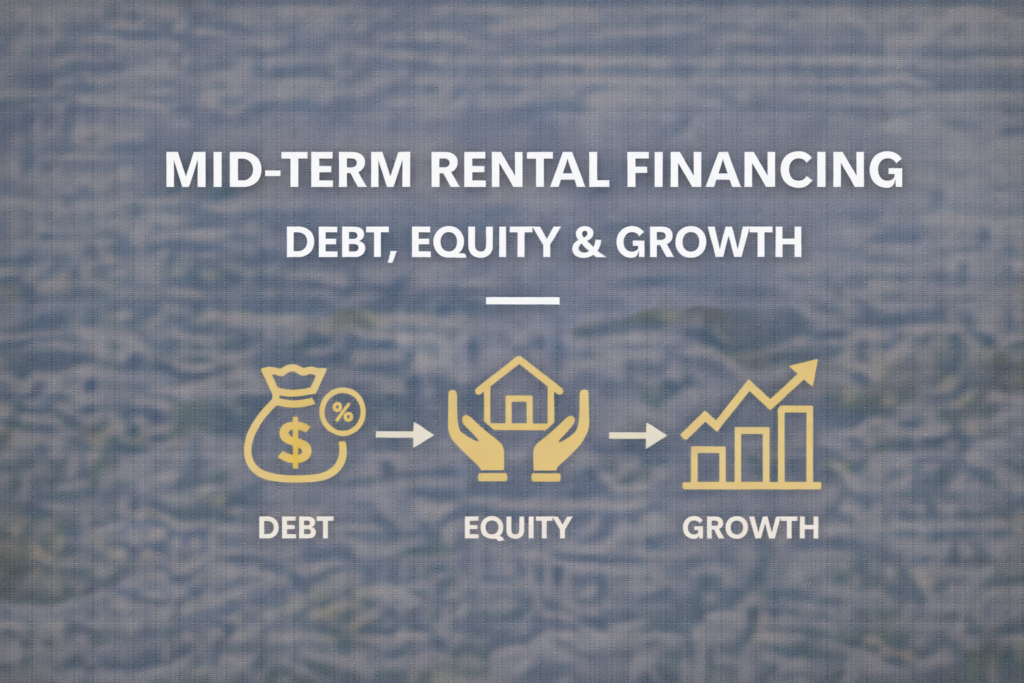
Financing & Capital Stack: Debt, Equity & Reinvestment Models
Mid-term rental financing is the backbone of any serious portfolio.
If your goal aligns with a Mid-Term Rental Portfolio Strategy: Capital, Growth & Exits, you cannot treat financing as an afterthought.
How you structure debt, equity, and reinvestment decisions determines speed, risk, and long-term control.
This is not about buying one property.
This is about building something durable.
Let’s break it down cleanly.
What Mid-Term Rental Financing Really Means
Mid-term rental financing is not identical to short-term or long-term rental funding.
Lenders, partners, and cash flow behave differently.
Key characteristics include:
- Furnished assets
- Higher upfront capital needs
- Stronger monthly cash flow than long-term rentals
- Less volatility than nightly short-term rentals
That combination changes how capital stacks should be built.
Understanding the Capital Stack
A capital stack is simply how a deal is funded.
Most mid-term rental portfolios use a mix of:
- Debt
- Equity
- Reinvested cash flow
The balance between these layers defines your risk profile and growth ceiling.
Debt Financing in Mid-Term Rentals
Debt is borrowed capital.
It accelerates growth but introduces obligation.
Common Debt Options
Conventional Mortgages
Still widely used for mid-term rentals, especially 30+ day stays.
DSCR Loans
Cash-flow-based underwriting.
Useful once properties stabilize.
Portfolio Loans
Ideal for operators holding multiple units under one lender relationship.
Private Debt
Higher rates, faster closings.
Often used for acquisitions or conversions.
Pros of Using Debt
- Preserves ownership
- Scales faster than cash
- Tax-efficient leverage
Risks of Over-Leverage
- Furnishing costs raise break-even points
- Vacancies hurt more when debt is high
- Rate changes impact margins
Smart mid-term rental financing uses measured leverage, not max leverage.
Equity Financing: When Capital Buys Speed
Equity is ownership capital.
You trade control for growth.
Common Equity Structures
Joint Ventures
One partner brings capital.
One partner operates.
Investor Syndicates
Multiple investors fund multiple units.
Operator earns fees and equity.
Friends & Family Equity
Simpler structures, higher trust, lower legal overhead.
When Equity Makes Sense
Equity is useful when:
- You lack upfront capital
- You want to scale faster than debt allows
- You are entering new markets
- You are converting multiple units at once
Equity reduces personal risk but caps upside.
Blended Capital Stacks (Most Common)
Most successful portfolios combine debt + equity + reinvestment.
Example structure:
- 65% debt
- 25% investor equity
- 10% operator capital
As cash flow stabilizes, equity gets bought out or diluted through reinvestment.
This is where portfolios start compounding.
Reinvestment Models: The Quiet Growth Engine
Reinvestment is the most underrated part of mid-term rental financing.
Instead of pulling cash out, operators:
- Re-furnish additional units
- Enter new sub-markets
- Upgrade existing listings
- Reduce reliance on new capital
Common Reinvestment Strategies
Cash Flow Roll-Forward
Monthly profits fund the next unit.
Stabilize → Expand
Wait 90–120 days, then redeploy.
Market Clustering
Reinvest within the same city to reduce operational drag.
Reinvestment builds leverage without increasing risk.
Financing Furnishings and Setup Costs
Mid-term rentals are not just real estate plays.
They are operational businesses.
Capital must cover:
- Furniture packages
- Housewares
- Utilities deposits
- Internet and tech
- Cleaning setup
Some operators separate real estate debt from furnishing capital.
Others bundle it into higher-leverage loans.
The key is planning for it upfront.
How Exit Strategy Is Shaped by Mid-Term Rental Financing
Your exit is baked into your capital stack.
Common Exit Paths
- Refinance stabilized assets
- Sell to another operator
- Convert to long-term rentals
- Portfolio sale
Over-complicated equity makes exits harder.
Clean financing makes exits flexible.
This is why disciplined operators design financing with the end in mind.
How Marketplaces Support Mid-Term Rental Financing Stability
Stable demand reduces financial risk.
That’s where purpose-built platforms matter.
Mid-term marketplaces help:
- Shorten vacancy periods
- Improve revenue predictability
- Support lender confidence
- Reduce marketing overhead
Platforms focused on 30+ day stays align better with financing models than nightly platforms.
This stability supports long-term capital planning.
Mid-Term Rental Financing Mistakes to Avoid
- Over-leveraging early
- Ignoring furnishing capital
- Mixing short-term assumptions with mid-term math
- Taking passive equity too soon
- Scaling before stabilization
Most portfolio failures start with financing shortcuts.
Capital Discipline as the Core of Mid-Term Rental Financing Strategy
Mid-term rental financing works best when paired with a long-term view.
That means thinking beyond the next unit.
A true Mid-Term Rental Portfolio Strategy: Capital, Growth & Exits prioritizes:
- Sustainable leverage
- Controlled equity use
- Predictable reinvestment
- Clean exit optionality
The second-largest risk in mid-term rentals is bad capital structure.
The first is ignoring it altogether.
Final Thoughts on Mid-Term Rental Financing and Portfolio Growth
Mid-term rental financing is not about finding money.
It is about structuring capital to support growth without breaking stability.
When debt, equity, and reinvestment work together, portfolios compound faster and survive longer.
That balance is what separates operators from owners.
If you are building or scaling 30+ day furnished rentals, explore tools and listings designed specifically for this model at https://ministays.com.