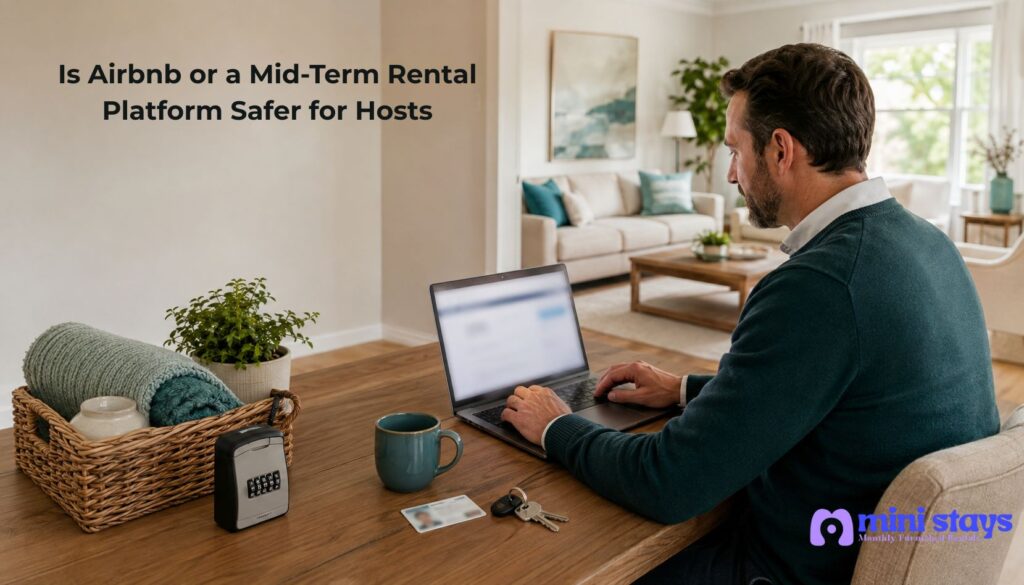
Is Airbnb or a Mid-Term Rental Platform Safer for Hosts? A 2026 Comparison
If you’re wondering which is safer for hosts Airbnb or mid-term rental platforms, the answer depends on the type of risk you’re trying to reduce. Airbnb offers extensive trust and safety tools backed by a global marketplace, while dedicated mid-term rental platforms are designed for longer stays with verified renters, structured payments, and fewer guest turnovers. In our experience hosting mid-term rentals, fewer turnovers and better-qualified tenants generally reduce operational risk for landlords.

Which Is Safer for Hosts: Airbnb or Mid-Term Rental Platforms?
When comparing which is safer for hosts Airbnb or mid-term rental platforms, safety extends beyond property damage. It includes tenant quality, payment security, identity verification, communication, legal compliance, and operational workload.
Verified guests matter. Platforms with identity verification reduce the likelihood of fraudulent bookings and fake accounts.
Fewer turnovers reduce risk. Longer stays mean fewer check-ins, fewer cleanings, and fewer opportunities for accidental damage.
Secure payment processing. Platforms that handle payments reduce the need for landlords to exchange payment details directly with guests.
Better tenant expectations. Guests booking monthly furnished housing typically behave more like tenants than vacation travelers.
Airbnb vs Mid-Term Rental Platforms: Safety Comparison
| Safety Factor | Airbnb | Mid-Term Rental Platforms |
|---|---|---|
| Identity verification | Available for many users | Commonly required on dedicated platforms |
| Guest stay length | 1 night to several months | Usually 30–90+ days |
| Turnover frequency | High | Low |
| Payment processing | Platform-managed | Platform-managed on many dedicated marketplaces |
| Tenant screening | Host responsibility with platform tools | Often combines verification with host screening |
| Best for | Flexible hosting | Lower operational risk |
1. Identity Verification
Winner: Mid-term rental platforms.
Many dedicated mid-term rental platforms require identity verification for both hosts and renters before bookings are confirmed. This creates an additional layer of trust before someone occupies the property.
Safety driver: Government-issued ID verification, email verification, phone verification.
Key figure: Most mid-term platforms focus on stays of 30 days or longer.
Context: Verification does not replace tenant screening, but it helps reduce fraudulent bookings.
2. Tenant Screening
Winner: Mid-term rental platforms for longer stays.
One of the biggest differences when evaluating which is safer for hosts Airbnb or mid-term rental platforms is the screening process.
Longer-term renters often expect additional qualification steps, including employment verification, assignment letters, rental history, and references.
Safety driver: Travel nurses, corporate employees, relocating professionals.
Best practice: Verify employment, occupancy, and intended use of the property.
Context: Screening must always comply with local housing laws and fair housing regulations.
For a repeatable process, see guest screening for mid-term rentals.
3. Property Damage Risk
Winner: Mid-term rental platforms.
Monthly renters generally treat furnished accommodations more like a temporary home than a vacation property.
Because there are fewer guest turnovers, landlords also reduce the number of cleaning appointments, maintenance visits, and move-ins each year.
Safety driver: Lower turnover frequency.
Typical comparison:
- Airbnb: dozens of check-ins annually
- Mid-term rentals: significantly fewer occupants
Context: No platform eliminates damage risk, making security deposits and insurance important regardless of stay length.
4. Payment Security
Winner: Tie.
Both Airbnb and many dedicated mid-term rental platforms process payments securely through their booking systems.
For monthly stays, many platforms also collect payments in scheduled installments instead of requiring the entire rental amount upfront.
Safety driver: Secure payment processing.
Best practice: Never request off-platform payments unless permitted by the platform’s policies.
Context: Hosts should always review payout schedules before accepting reservations.
5. Communication and Fraud Prevention
Winner: Airbnb for marketplace scale; Mid-term platforms for specialized renters.
Airbnb has invested heavily in fraud detection and messaging protections because of its global marketplace.
Dedicated mid-term rental platforms often benefit from serving a narrower audience of professionals seeking legitimate housing rather than vacation accommodations.
Safety driver: Platform messaging and verified profiles.
Context: Keep all booking conversations on-platform whenever possible.
6. Legal and Operational Risk
Winner: Mid-term rental platforms.
Many cities regulate short-term rentals differently from monthly furnished rentals. Depending on local laws, operating 30+ day stays may involve fewer short-term rental restrictions.
Safety driver: Longer lease periods.
Typical stay: 30–90+ days.
Context: Hosts should always verify local regulations because laws vary by city and state.
7. Insurance Considerations
Winner: Depends on the policy.
Neither Airbnb’s protection programs nor a platform’s verification process replaces comprehensive landlord insurance.
Hosts should maintain insurance that specifically covers furnished mid-term rentals, liability, and property damage.
Safety driver: Appropriate insurance coverage.
Best practice: Review your policy annually as your rental strategy changes.
Learn more about mid-term rental insurance.
Which Is Safer for Hosts: Airbnb or Mid-Term Rental Platforms?
For landlords whose primary business is monthly furnished housing, mid-term rental platforms generally provide the safer operating environment because they focus on:
- Longer tenant stays
- Lower turnover
- Better-qualified renters
- Structured monthly payments
- Identity verification
- Fewer operational handoffs
Airbnb remains an excellent platform for hosts who value flexibility and global exposure, but its broader audience naturally introduces more variation in guest behavior and booking types.
How to Improve Host Safety on Any Platform
- Verify every renter’s identity.
- Use consistent tenant screening procedures.
- Keep all payments on the platform.
- Require a written rental agreement when appropriate.
- Carry insurance designed for furnished rentals.
Our landlord’s guide to mid-term rentals covers additional strategies for reducing risk while improving occupancy.
Final Verdict
When asking which is safer for hosts Airbnb or mid-term rental platforms, the answer is clear for most landlords specializing in monthly furnished housing.
Dedicated mid-term rental platforms generally offer lower operational risk through longer stays, fewer turnovers, structured payment systems, and renter verification. Airbnb continues to be a powerful marketplace, but hosts should supplement its built-in protections with thorough tenant screening, proper insurance, and clear house rules.
If you’re building a portfolio focused on monthly furnished rentals, list your property on ministays to reach verified renters seeking 30–90+ day stays.
FAQ
Which is safer for hosts Airbnb or mid-term rental platforms?
For most monthly furnished rental hosts, dedicated mid-term rental platforms are generally safer because they attract longer-term tenants, reduce guest turnover, and often include identity verification and structured payment systems.
Are mid-term rentals safer than Airbnb?
Mid-term rentals can reduce operational risks because hosts manage fewer check-ins and check-outs while renting to professionals who typically need temporary housing rather than vacation accommodations.
Does tenant screening improve host safety?
Yes. Proper tenant screening helps verify identity, employment, rental history, and occupancy plans before accepting a booking. It is one of the most effective ways to reduce host risk.
Does Airbnb verify guests?
Airbnb uses identity verification and trust systems for many users, but hosts should still communicate with guests, review profiles, and follow consistent screening practices for longer stays.
Should hosts require rental agreements for 30-day stays?
Many hosts use written rental agreements for monthly furnished stays to clearly define payment schedules, occupancy limits, house rules, and responsibilities. Requirements vary by jurisdiction.
Is landlord insurance necessary for mid-term rentals?
Yes. Specialized insurance helps protect hosts against liability, property damage, and other risks that platform protections alone may not cover.