Long-Term Furnished Apartments for Rent in Major U.S. Cities: 8 Markets for 2026
Finding long-term furnished apartments for rent in major U.S. cities is easiest when you search platforms and neighborhoods built around monthly stays rather than nightly tourism. In our experience with furnished rentals, the best options balance flexible 30–90+ day terms, utilities, reliable Wi-Fi, practical furnishings, and convenient access to employers, hospitals, universities, or transit.
What Makes a Good Long-Term Furnished Apartment?
Flexible lease length. The best furnished properties clearly state whether they accept 30-, 60-, 90-day, six-month, or longer stays.
Transparent monthly costs. Renters should know whether electricity, water, gas, Wi-Fi, parking, cleaning, and other expenses are included before comparing properties.
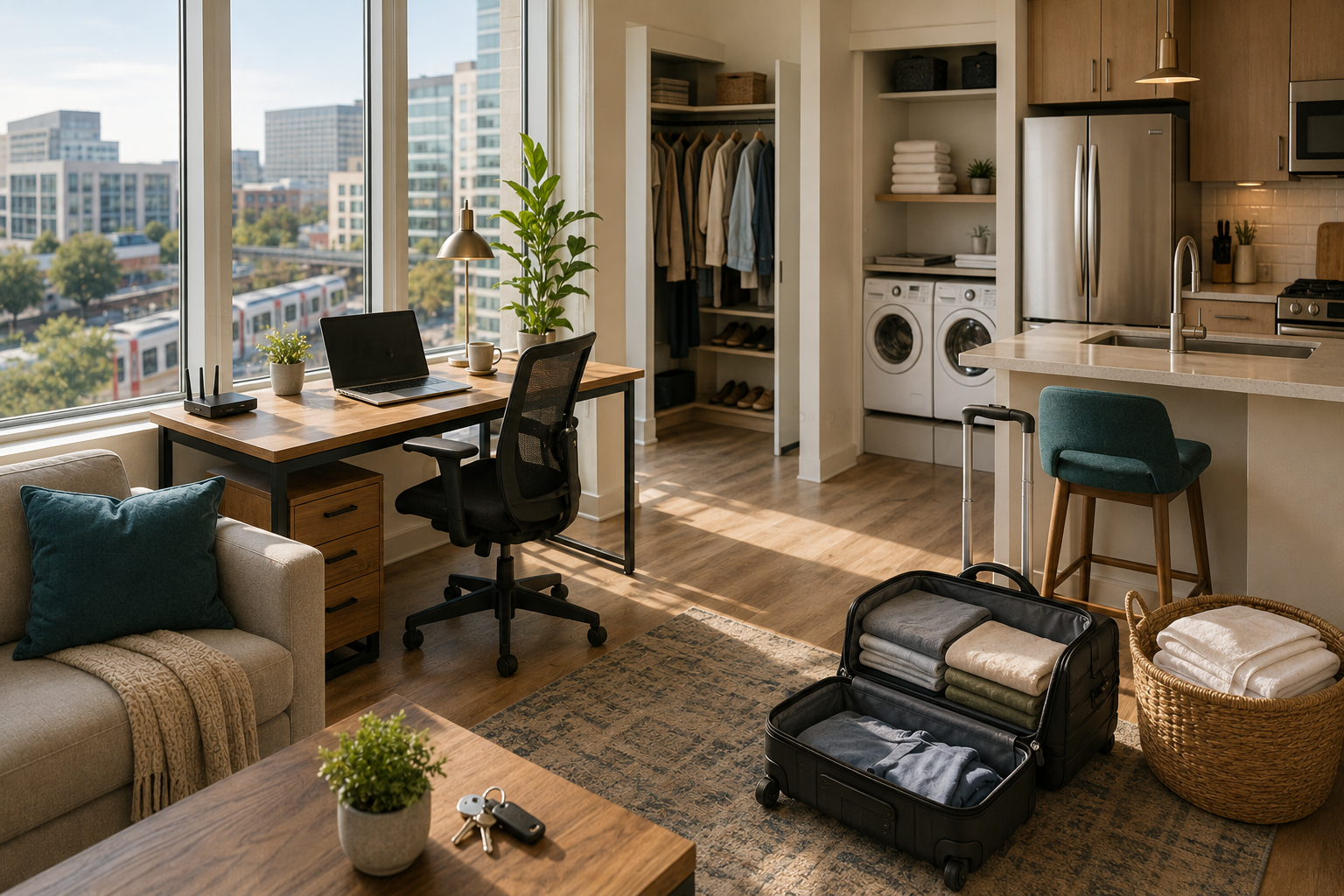
Actually move-in ready. A furnished apartment should include more than a bed and sofa. A functional kitchen, laundry access, storage, workspace, linens, and reliable internet matter during an extended stay.
Useful location. Proximity to hospitals, employers, universities, military installations, or transit can be more important than being in the city’s best-known tourist neighborhood.
Clear screening and lease terms. Renters and landlords should understand deposits, cancellation rules, pet policies, application requirements, and the agreement governing the stay.
Where to Find Long-Term Furnished Apartments for Rent in Major U.S. Cities
Renters looking for monthly furnished apartments can start with specialized mid-term rental marketplaces, corporate housing providers, furnished apartment operators, and conventional rental platforms that allow furnished filters.
For 30–90+ day stays, ministays is designed around furnished mid-term housing rather than short vacation stays. This can be particularly useful for traveling professionals, remote workers, relocating employees, travel nurses, military households, and renters between permanent homes.
The wider U.S. rental market remains substantial. Zillow reported the typical U.S. asking rent at $1,962 in July 2026, up 2.3% year over year. These conventional rents are useful benchmarks, but furnished apartments may cost more because furniture, flexibility, utilities, Wi-Fi, and other services can be included.
Here are eight major markets renters should research.
1. New York City: Best for Corporate and Professional Stays
Why it ranks / Best for: New York has enormous rental inventory and demand from finance, healthcare, technology, consulting, universities, entertainment, and corporate relocation.
Demand drivers: NYU Langone Health, NewYork-Presbyterian, Mount Sinai, Columbia University, NYU, JPMorgan Chase, financial services, technology companies, and professional services.
According to Zillow’s New York rental market data, average asking rent was approximately $3,700 across all bedrooms and property types in late August 2026.
Context: That $3,700 figure is a broad rental-market benchmark, not a furnished monthly rate. Furnished pricing varies dramatically by borough, neighborhood, bedroom count, lease length, and amenities.
For long-term furnished rentals, renters should begin with the location of their workplace or hospital rather than automatically choosing Manhattan. Brooklyn, Queens, and other areas may offer different trade-offs between commute, space, and cost.
2. Los Angeles: Best for Healthcare, Entertainment, and Relocations
Why it ranks / Best for: Los Angeles offers a huge and geographically diverse rental market serving healthcare professionals, entertainment workers, corporate travelers, students, and relocating households.
Demand drivers: UCLA, UCLA Health, Cedars-Sinai, USC, entertainment studios, technology employers, and the broader Southern California business economy.
2026 number: Zillow reported average Los Angeles rent of approximately $2,650 as of August 30, 2026, with more than 18,000 rentals represented in its dataset.
Context: Los Angeles is highly commute-sensitive. A furnished apartment that appears centrally located on a map may still create a difficult daily drive.
Renters searching for furnished apartments in major cities should therefore compare realistic commute times, parking, neighborhood amenities, and proximity to their actual destination. The best long-term furnished apartments for rent major U.S. cities offer combine flexible lease terms, practical furnishings, transparent monthly costs, and convenient access to the renter’s primary destination.
3. Chicago: Best Big-City Value in This Comparison
Why it ranks / Best for: Chicago combines major-city employment, healthcare, universities, and public transportation with a lower broad rental benchmark than New York, Boston, Los Angeles, or San Francisco.
Demand drivers: Northwestern Medicine, Rush University Medical Center, University of Chicago, major consulting firms, finance employers, universities, and corporate headquarters.
2026 number: Zillow reported average Chicago rent of approximately $2,000 on September 2, 2026, essentially unchanged from the prior year.
Context: Furnished rents can exceed the conventional $2,000 benchmark. Neighborhood, bedroom count, proximity to transit, utilities, parking, and furnishing quality all influence monthly pricing.
Chicago can be particularly attractive for renters who want a dense urban environment without New York or San Francisco’s broad-market rent levels.
4. Dallas: Best for Corporate Relocations
Why it ranks / Best for: Dallas offers extensive corporate and healthcare demand with a broad rental benchmark below many coastal cities.
Demand drivers: UT Southwestern Medical Center, Baylor University Medical Center, financial services, telecommunications, technology, consulting, and the wider Dallas-Fort Worth corporate economy.
2026 number: Zillow reported an average Dallas rent of approximately $1,950 on August 27, 2026, down $45 from the prior year.
Context: Dallas-Fort Worth is geographically large, so renters should avoid choosing a unit simply because it is advertised as being “in DFW.” Commute distance to the actual workplace or hospital matters.
This makes Dallas particularly suitable for monthly furnished apartments serving corporate relocations, project workers, clinicians, and households moving between permanent homes. Demand for long-term furnished apartments for rent major U.S. cities provide is often strongest near corporate offices, hospitals, universities, and other employment hubs where temporary professionals need flexible housing.
5. Washington, D.C.: Best for Government and Project-Based Professionals
Why it ranks / Best for: Washington offers recurring temporary-housing demand from government, consulting, defense, nonprofit, healthcare, diplomatic, and professional-services sectors.
Demand drivers: Federal agencies, Georgetown University, George Washington University, major hospitals, consulting firms, defense contractors, nonprofits, and international organizations.
2026 number: Zillow reported average Washington rent of approximately $2,500 in September 2026, about 25% above its stated national comparison.
Context: Renters should consider both the District and nearby Maryland and Northern Virginia locations depending on their workplace and transit needs.
For longer assignments, Metro access can be more valuable than simply selecting the most central address.
6. Boston: Best for Healthcare and University Stays
Why it ranks / Best for: Boston’s concentration of hospitals, universities, research institutions, biotechnology employers, and professional services creates a natural market for furnished housing.
Demand drivers: Massachusetts General Hospital, Brigham and Women’s Hospital, Boston Children’s Hospital, Harvard University, MIT, Boston University, biotechnology firms, and research institutions.
2026 number: Zillow reported an average Boston rent of approximately $3,400 on August 28, 2026, up $100 from the previous year.
Context: Boston’s conventional rental benchmark is already high, so furnished renters should carefully compare what is included in the monthly rate.
Medical professionals looking for temporary housing can also review our travel nurse housing resources for guidance on furnished stays near healthcare employers.
7. Seattle: Best for Technology and Healthcare Professionals
Why it ranks / Best for: Seattle combines technology, healthcare, universities, and corporate employment with substantial rental inventory.
Demand drivers: Amazon, Microsoft across the broader region, University of Washington, UW Medicine, Seattle Children’s, technology companies, and professional services.
2026 number: Zillow reported an average Seattle rent of approximately $2,195 on August 29, 2026, down $29 from a year earlier.
Context: Renters should compare Seattle proper with nearby employment centers such as Bellevue and Redmond when their job location permits.
For remote or hybrid professionals, a dedicated workspace and reliable internet can be as important as proximity to a downtown office.
8. San Francisco: Best for Higher-Budget Professional Stays
Why it ranks / Best for: San Francisco remains relevant for technology, healthcare, finance, biotechnology, and professional assignments, but renters should prepare for a high-cost market.
Demand drivers: UCSF Health, Salesforce, technology and AI companies, financial services, biotechnology employers, and the wider Bay Area innovation economy.
2026 number: Zillow’s Rental Manager reported an average San Francisco asking rent of approximately $4,765 as of August 29, 2026.
Context: The citywide average includes many property types and bedroom counts and should not be treated as the expected price of a specific furnished apartment.
Renters considering furnished city rentals should compare San Francisco with nearby Bay Area communities based on workplace location, transit, lease flexibility, and total monthly cost.
Long-Term Furnished Apartments in Major Cities: Rent Comparison
Broad-market rent data provides a useful starting point when comparing cities, but these figures are not furnished-apartment quotes.
| City | 2026 Broad Rental Benchmark | Strongest Extended-Stay Drivers |
|---|---|---|
| Dallas | $1,950 | Corporate, healthcare |
| Chicago | $2,000 | Corporate, healthcare, universities |
| Seattle | $2,195 | Technology, healthcare |
| Washington, D.C. | $2,500 | Government, consulting, defense |
| Los Angeles | $2,650 | Healthcare, entertainment |
| Boston | $3,400 | Healthcare, universities, biotech |
| New York City | $3,700 | Corporate, healthcare, finance |
| San Francisco | $4,765 | Technology, healthcare, finance |
When comparing long-term furnished apartments for rent major U.S. cities offer, renters should look beyond headline rent and consider utilities, furnishings, Wi-Fi, parking, commute time, and lease flexibility. Current Zillow data shows just how wide the cost range can be. Dallas averaged about $1,950 in late August, while San Francisco’s reported average was $4,765.
A furnished property may carry a premium over these figures because the monthly price can include furniture, utilities, internet, parking, or other conveniences. Always compare the total cost of occupancy, not just advertised rent.
Monthly Furnished Apartments vs. Traditional Rentals
For renters staying several months, the decision usually comes down to flexibility versus cost.
| Feature | Monthly Furnished Apartment | Traditional Rental |
|---|---|---|
| Furniture | Included | Usually not |
| Typical flexibility | 30–90+ days possible | Often 12 months |
| Utilities | Often bundled or simplified | Usually separate |
| Wi-Fi | Often included | Usually renter-arranged |
| Setup time | Low | Higher |
| Moving furniture | Usually unnecessary | Often required |
| Monthly price | Often higher | Usually lower |
| Best for | Temporary stays | Permanent housing |
Monthly furnished apartments are particularly useful when the renter knows the stay is temporary. Travel nurses, consultants, relocating employees, military households, remote workers, visiting academics, and people between homes may value flexibility enough to justify a higher monthly cost.
Traditional rentals usually make more sense when a renter expects to remain for a year or longer and is comfortable furnishing the property and establishing utilities.
Where Should You Search for Furnished City Rentals?
Start with platforms designed for the length of stay you actually need. A traveler looking for 60 days has different requirements from a tourist booking four nights or a tenant signing a 12-month lease.
When reviewing long-term furnished rentals, check whether the listing clearly provides the minimum stay, maximum stay, deposit, utility policy, Wi-Fi, furniture inventory, parking, pet rules, cancellation terms, and screening requirements.
Do not rely on photos alone. Ask whether the kitchen is fully equipped, whether laundry is private or shared, what internet speed is available, and whether the workspace is suitable for full-time remote work.
Renters comparing marketplace options can also review our guide to Furnished Finder alternatives for other ways to search for monthly furnished housing.
How to Find Long-Term Furnished Apartments for Rent in Major U.S. Cities
- Choose the exact neighborhood or commute radius. Start with your employer, hospital, university, military installation, or other destination and work outward.
- Set the full stay length. Search using your real arrival and departure dates. A property available for 30 days may not be available for six months.
- Compare total monthly cost. Add rent, utilities, internet, parking, pet charges, cleaning fees, deposits, and platform fees where applicable.
- Verify the property and terms. Review the lease, cancellation policy, payment process, screening requirements, landlord information, and property details before sending funds.
- Compare at least three realistic options. The cheapest listing is not necessarily the best value. Commute, furniture, utilities, workspace, laundry, and flexibility can justify differences in monthly rent.
For more help choosing an extended-stay marketplace, see our mid-term rental platform comparison.
How Hosts Can Compete for Long-Term Furnished Renters
Hosts offering long-term furnished apartments should market the property around the needs of temporary residents, not vacationers.
State the monthly price clearly and explain which utilities are included. Give accurate commute information to nearby hospitals, employers, universities, and military installations. Include workspace, parking, laundry, Wi-Fi, storage, and pet information in the listing.
Pricing also needs to account for the costs of furnished operation. Utilities, internet, furniture replacement, cleaning, maintenance, vacancy, insurance, and platform expenses can erode the apparent premium over an unfurnished lease.
Our mid-term rental pricing guide explains how hosts can build a monthly rate around actual costs and market competition.
Are Long-Term Furnished Apartments Worth It?
Long-term furnished apartments are often worth considering when flexibility and convenience matter more than securing the lowest possible monthly rent. They eliminate furniture purchases and can simplify utilities, internet, and moving logistics.
The value is particularly clear for renters who know they will leave after a project, clinical assignment, relocation period, academic term, or temporary work arrangement.
However, renters staying for a year or longer should compare furnished pricing against a conventional lease. The longer the stay, the more important it becomes to calculate whether the furnished premium is still worthwhile.
Looking for flexible furnished housing or trying to reach renters who need it? Explore 30–90+ day furnished stays on ministays and connect around monthly housing rather than nightly travel.
FAQ
Where can I find long-term furnished apartments in major U.S. cities?
Start with mid-term rental marketplaces, corporate housing providers, furnished apartment operators, and rental platforms that support furnished searches. For 30–90+ day housing, focus on services designed around monthly stays. Compare lease length, total monthly cost, utilities, Wi-Fi, deposits, screening, location, and cancellation terms before booking.
How much do monthly furnished apartments cost?
Monthly furnished apartments vary widely by city, neighborhood, bedrooms, amenities, lease length, and included utilities. Recent broad-market benchmarks range from about $1,950 in Dallas to $4,765 in San Francisco, but those are conventional rental averages rather than furnished quotes. Furnished renters should compare current property-level listings.
Are furnished apartments cheaper than hotels for long stays?
They can be, particularly when comparing a complete apartment with a hotel for several weeks or months, but there is no universal rule. Compare the full cost for identical dates. Consider taxes, fees, parking, laundry, kitchen access, utilities, cleaning, workspace, and the value of having a separate living area.
Can I rent a furnished apartment for three months?
Yes. Many mid-term and corporate housing providers specialize in stays of roughly 30–90 days or longer. Availability and lease terms vary by property and jurisdiction, so confirm the minimum stay, deposit, utilities, extension policy, and exact departure date before signing. Three-month stays are common use cases for temporary furnished housing.
What is usually included in a long-term furnished rental?
A long-term furnished rental typically provides major furniture such as beds, seating, dining furniture, and basic kitchen equipment. Some properties also bundle electricity, water, gas, Wi-Fi, linens, parking, or cleaning. There is no universal standard, so renters should request a written list of furnishings and included expenses.
Which major U.S. cities are best for furnished rentals?
New York, Los Angeles, Chicago, Dallas, Washington, Boston, Seattle, and San Francisco all have substantial renter bases and major demand generators. The best choice depends on why you are traveling. Healthcare workers should prioritize hospital access, while corporate renters should compare commute times to their specific workplace.
What should I check before booking a furnished apartment?
Verify the address, landlord or provider, lease terms, total monthly cost, deposit, cancellation policy, utility limits, Wi-Fi, furniture, laundry, parking, pets, and move-in procedure. Read the agreement before paying. For longer stays, also confirm how extensions, maintenance requests, damages, and early termination are handled.