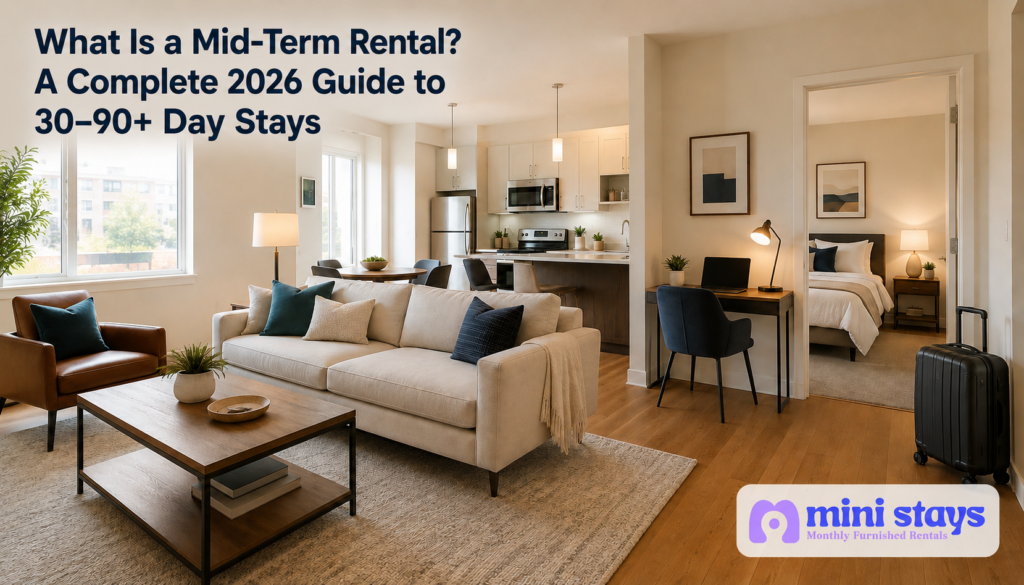
What Is a Mid-Term Rental? A Complete 2026 Guide to 30–90+ Day Stays
What is a mid term rental? A mid-term rental (MTR) is a furnished property rented for roughly 30 days to less than a year, with 30–90 day stays especially common. In our experience with MTRs, the biggest difference is flexibility: they give renters a move-in-ready home without a year-long lease while giving landlords longer occupancy than typical vacation rentals.

What Is a Mid Term Rental, and What Makes a Good One?
A good mid-term rental combines the convenience of furnished accommodation with the stability of a longer residential stay. Exact legal definitions vary by jurisdiction, so landlords and renters should always check local rental and tenancy rules.
Flexible lease length. A typical MTR starts around 30 days and can extend for several months, making it useful when a one-year lease is too long.
Move-in-ready furnishings. A strong furnished monthly rental includes the furniture and household essentials someone needs to live comfortably without moving an entire household.
Predictable monthly costs. Renters should know which expenses, such as Wi-Fi, electricity, water, parking, or other utilities, are included in the monthly price.
Practical location. The best MTRs are convenient to major demand drivers such as hospitals, corporate offices, universities, military installations, and employment centers.
Residential comfort. Kitchens, laundry access, reliable internet, workspace, parking, and sufficient storage become much more important during a 30–90+ day stay than during a weekend trip.
Mid-Term Rental Meaning: MTR vs. Short-Term vs. Long-Term Rental
The simplest mid-term rental meaning is temporary housing that sits between a short vacation stay and a traditional long-term lease.
| Feature | Short-Term Rental | Mid-Term Rental | Long-Term Rental |
|---|---|---|---|
| Typical stay | Nights or weeks | Roughly 30 days to several months | Usually 6–12+ months |
| Furnished | Usually | Usually | Often unfurnished |
| Pricing | Nightly/weekly | Monthly | Monthly |
| Utilities | Usually included | Often included or bundled | Often tenant-paid |
| Turnover | High | Moderate | Low |
| Typical renter | Vacationer | Professional, relocating renter, temporary resident | Permanent/local resident |
| Flexibility | Very high | High | Lower |
| Landlord workload | Higher turnover | Moderate | Generally lower turnover |
| Common use | Tourism | Temporary housing | Primary residence |
There is no single nationwide U.S. legal definition that makes every 30–90 day property a “mid-term rental.” Local laws may classify rentals differently based on duration, property type, zoning, tenancy rules, or licensing requirements.
That distinction matters for landlords. A 31-day rental may fall outside short-term rental rules in one city but still trigger landlord-tenant obligations or other regulations.
How Does a 30–90 Day Rental Work?
A 30–90 day rental generally works like a temporary furnished lease. The renter chooses a property available for the required period, confirms pricing and included expenses, completes any application or verification requirements, signs the applicable rental agreement, and moves into an already furnished home.
For landlords, the process typically involves marketing the property, qualifying the renter, documenting lease terms, collecting required payments or deposits, preparing the property, and coordinating move-in and move-out.
The monthly rate may account for more than base rent because a furnished MTR can include furniture, internet, utilities, housewares, and the value of flexible lease terms.
The exact structure varies by platform and property. Renters should confirm the total price and lease terms rather than assuming every monthly rental includes the same services.
Who Uses Medium-Term Rentals?
A medium-term rental is useful whenever someone needs a home for several weeks or months but does not want to furnish an apartment or sign a conventional year-long lease.
Travel healthcare professionals: Travel nurses, therapists, physicians, technicians, and other healthcare workers may need temporary housing near hospitals during assignments.
Corporate travelers: Consultants, project teams, executives, and employees on temporary assignments often need housing that feels more residential than a hotel.
Relocating professionals: Someone moving to a new city may use an MTR while starting a job, learning neighborhoods, or waiting for permanent housing.
Remote workers and digital professionals: Flexible workers can use monthly furnished housing when spending several months in another city.
Military personnel and families: PCS moves, temporary duty, training, and transitions between homes can create temporary furnished-housing needs.
Students and visiting academics: Internships, semester programs, research appointments, and visiting faculty positions do not always align with 12-month leases.
Insurance-displacement renters: Families may need temporary furnished housing while a damaged home is repaired or rebuilt.
Snowbirds and seasonal residents: Renters who spend part of the year in another region can use furnished monthly housing without purchasing or maintaining a second home.
Why Are Mid-Term Rentals Popular With Renters?
For renters, the main advantage of a mid-term rental is the balance between flexibility and livability. A furnished monthly rental provides a temporary home without requiring furniture purchases, utility setup, or a year-long commitment.
A 60- or 90-day stay can also make residential features more valuable. A full kitchen, separate bedroom, laundry, desk, parking, and neighborhood access may matter much more after several weeks than they would during a short hotel visit.
MTRs can also make moving simpler. A relocating employee, for example, can begin work immediately and search for permanent housing after arriving rather than choosing a neighborhood remotely under deadline pressure.
The tradeoff is that monthly furnished housing may cost more per month than an otherwise comparable unfurnished annual lease. Renters are paying partly for furnishings, flexibility, and move-in readiness.
Why Do Landlords Choose Mid-Term Rentals?
For landlords, mid-term rentals can occupy a useful middle ground between nightly vacation rentals and annual leases.
A 30–90 day rental generally means fewer turnovers than a property booked for two- or three-night stays. That can reduce the frequency of cleaning, guest communication, check-ins, and calendar gaps.
At the same time, MTR landlords may retain more pricing and availability flexibility than with a conventional one-year lease. A property can potentially serve different demand segments throughout the year, depending on local rules and market conditions.
The tradeoff is additional management compared with some traditional leases. Furnishings need maintenance, utilities may need to be managed, and landlords must repeatedly market the property and qualify new renters.
For a deeper landlord-focused overview, read our landlord’s guide to mid-term rentals.
What Should a Furnished Monthly Rental Include?
A furnished monthly rental should provide enough essentials for someone to live normally from the first day of the lease.
At minimum, renters commonly expect appropriate bedroom and living-room furniture, a functional kitchen, reliable Wi-Fi, window coverings, basic lighting, and essential household equipment. Laundry access, a workspace, parking, and outdoor space can strengthen a property’s appeal depending on the market.
Landlords should also state clearly what is included. If electricity is capped, parking costs extra, pets require a fee, or the renter is responsible for a particular utility, disclose that before the lease is signed.
For remote workers and corporate renters, internet reliability can be particularly important. For travel nurses, shift-friendly parking and reasonable commuting distance to hospitals may be stronger selling points.
How Much Does a Mid-Term Rental Cost?
There is no universal price for a mid-term rental. Rates vary significantly by city, neighborhood, property size, furnishings, season, local supply, utilities, amenities, and length of stay.
A furnished monthly property can command a different rate from an unfurnished annual rental because the landlord may be providing furniture, Wi-Fi, utilities, housewares, flexible terms, and other services. However, the market ultimately determines what renters will pay.
Landlords should compare their property against other furnished monthly rentals with similar locations, bedroom counts, amenities, and lease lengths rather than simply multiplying a nightly vacation-rental price by 30.
For a step-by-step method, use our mid-term rental pricing guide.
Renters should compare the total monthly housing cost, including rent, utilities, parking, pet charges, deposits, cleaning costs, and any platform or payment fees.
Where Can You Find Mid-Term Rentals?
Renters can find MTRs through specialized mid-term rental platforms, general rental websites, vacation-rental marketplaces that permit longer stays, corporate-housing providers, local property managers, and direct landlord listings.
Specialized platforms can be useful because renters arrive specifically looking for furnished monthly housing. General marketplaces may provide larger inventories but can require more filtering to separate annual leases, vacation rentals, and genuine 30–90+ day properties.
Landlords often benefit from using multiple channels until they know which sources generate qualified renters in their market.
For a comparison of available options, see our guide to mid-term rental platforms and Furnished Finder alternatives.
Are Mid-Term Rentals Legal?
Mid-term rentals can be legal, but the applicable rules depend on the property’s location and the length and structure of the tenancy. There is no single U.S. rule that governs every MTR.
Cities and states may regulate short-term rentals, leases, security deposits, tenant screening, habitability, taxes, licensing, rent increases, eviction, and other aspects of the landlord-tenant relationship differently.
Homeowners associations and condominium associations may also impose minimum lease lengths or other restrictions even when local law permits the rental.
Landlords should therefore verify city, county, state, HOA, insurance, mortgage, and applicable tax requirements before operating an MTR. Do not assume that staying above a city’s short-term-rental threshold automatically removes every regulatory obligation.
Is a Mid-Term Rental the Same as Corporate Housing?
Not exactly. Corporate housing is one important segment of the mid-term rental market, but medium-term rentals serve a broader audience.
Corporate housing generally targets employees, consultants, executives, project teams, and relocating workers. An MTR can serve those renters while also housing travel nurses, military families, students, remote workers, displaced homeowners, snowbirds, and people between permanent residences.
Both models commonly emphasize furnished, move-in-ready housing and flexible lease periods.
The distinction is mainly audience and positioning: corporate housing describes a specific temporary-housing use case, while mid-term rental describes the broader rental-duration model.
How to Evaluate a Mid-Term Rental in 5 Steps
- Confirm the exact stay length. Determine whether you need 30, 60, 90, or more days and make sure the property’s minimum and maximum lease terms match your dates.
- Calculate the all-in monthly cost. Add rent, utilities, parking, pet charges, deposits, cleaning costs, and mandatory fees so you can compare properties fairly.
- Check everyday essentials. Confirm furniture, kitchen equipment, laundry, Wi-Fi, workspace, parking, storage, and any other features you will need during a multi-month stay.
- Review the agreement carefully. Understand payment dates, deposits, cancellation or early-termination provisions, extensions, guest rules, pets, maintenance responsibilities, and move-out requirements.
- Verify the property and transaction. Confirm who you are renting from, document the agreement, use appropriate payment methods, and keep copies of important communications and receipts.
If you need a move-in-ready home without committing to a year-long lease, explore furnished monthly rentals with ministays for stays of 30 days and longer.
FAQ
What is a mid term rental?
What is a mid term rental? It is temporary housing generally rented for at least 30 days and less than a traditional long-term lease, often for 30–90 days or several months. Most MTRs are furnished and appeal to travel professionals, relocating employees, remote workers, military families, students, and other temporary residents.
What is the mid-term rental meaning in real estate?
The mid-term rental meaning in real estate generally refers to a rental period between short vacation stays and conventional long-term leases. A typical MTR lasts at least a month and may continue for several months. The term is an industry description, however, and local laws may define rental durations differently.
What is the difference between short-term and medium-term rentals?
A short-term rental usually accommodates stays measured in nights or weeks, while a medium-term rental generally begins around 30 days and lasts for several months. MTRs are typically furnished and priced monthly. Longer stays also mean fewer turnovers, while local tenancy and rental regulations may differ once a stay crosses certain duration thresholds.
Is a 3-month rental considered a mid-term rental?
Yes, a three-month or roughly 90-day rental is commonly considered a mid-term rental in the housing industry. It falls between a short vacation stay and a traditional annual lease. However, “mid-term rental” is not a universal legal classification, so the rules affecting a 90-day tenancy depend on the property’s jurisdiction.
Are mid-term rentals usually furnished?
Yes, most mid-term rentals are marketed as furnished monthly rentals because temporary renters typically want move-in-ready housing. Furnishings may include beds, seating, dining furniture, kitchen equipment, and other household essentials. Internet and utilities are also frequently included or bundled, but renters should verify exactly what each property’s monthly price covers.
Who typically rents a 30–90 day rental?
A 30–90 day rental can serve travel nurses, corporate employees, consultants, remote workers, relocating families, military personnel, visiting academics, interns, insurance-displacement renters, and people between permanent homes. Their common need is temporary residential housing that lasts longer than a typical trip but does not require a conventional year-long commitment.
Is a mid-term rental cheaper than a hotel?
A mid-term rental can cost less than a hotel over a long stay, but that is not guaranteed. Prices vary by city, property, dates, and amenities. Compare the full 30-, 60-, or 90-day cost, including taxes, utilities, parking, cleaning, pet charges, and other mandatory fees, rather than comparing nightly and monthly headline rates.